🌟 GEO SEO Analyzer by Geo SEO Lab
🌟 🌟 Geo SEO Lab’s GEO SEO Analyzer is an AI-powered website audit tool that delivers dual SEO + GEO scores in seconds. Analyze 200+ optimization factors across SEO, GEO, technical performance, content, local search, UX, security, and AI visibility. Discover how ready your website is for Google Search, ChatGPT, Gemini, Perplexity, and AI Overviews- with actionable fixes to improve rankings, citations, and future search visibility in 2026.

The Future of Search Has Already Changed
For years, Search Engine Optimization (SEO) was all about ranking higher on Google. Businesses focused on keywords, backlinks, page speed, and technical optimization to earn a place on the first page of search results. While these fundamentals still matter, the way people discover information online has changed dramatically.
Today, millions of users no longer rely only on traditional search engines. Instead, they ask questions directly to AI-powered assistants like ChatGPT, Google AI Overviews, Gemini, Claude, Perplexity AI, and Microsoft Copilot. Rather than displaying a list of blue links, these platforms generate complete answers by analyzing information from multiple trusted sources across the web.This shift has created a new challenge for website owners. Ranking on Google is no longer enough if your content isn't also recognized, understood, and cited by AI systems. A website may perform well in traditional search results but still receive little or no visibility inside AI-generated answers.As a result, digital marketing has entered a new era where websites must optimize for both traditional search engines and generative AI platforms. Businesses that ignore this shift risk losing visibility, traffic, and potential customers as more users rely on AI-generated responses instead of clicking through search results.This is where Generative Engine Optimization (GEO) comes into the picture. GEO focuses on improving a website's ability to become a trusted source for AI-powered search experiences. It emphasizes semantic relevance, structured data, entity recognition, conversational content, trust signals, and citation readiness—factors that help AI models understand and reference your content accurately.Unlike traditional SEO, which mainly measures ranking positions and organic traffic, GEO evaluates whether your website is prepared for AI search ecosystems. Modern websites need to answer questions clearly, provide structured information, demonstrate expertise, and establish strong trust signals if they want to appear in AI-generated responses.The search landscape is evolving faster than ever before. Google is investing heavily in AI Overviews, Microsoft continues to enhance Copilot, OpenAI is expanding ChatGPT's search capabilities, and other AI platforms are changing how users interact with information. Instead of searching with short keywords, people now ask complete questions in natural language, expecting instant and accurate answers.For businesses, agencies, bloggers, eCommerce stores, SaaS companies, publishers, and local brands, this means that optimization strategies must evolve as well. Success is no longer determined solely by keyword rankings but also by how effectively your content can be interpreted, trusted, and cited by AI systems.The websites that adapt early will enjoy greater visibility across both traditional search engines and emerging AI platforms. Those that delay may find themselves losing opportunities as search behavior continues to shift toward conversational AI experiences.That is why measuring both SEO performance and AI visibility has become essential. Understanding where your website stands today is the first step toward building a stronger digital presence for the future.Geo SEO Lab’s GEO SEO Analyzer bridges this gap. It’s an advanced AI-powered audit tool that analyzes your website across 200+ parameters in 7 key optimization categories and gives you two clear, actionable scores:
SEO Score — Traditional search engine readiness
GEO Score — Generative Engine Optimization (AEO/GEO) and AI visibility readiness
Whether you run a blog, e-commerce site, or agency, this tool shows exactly where you stand in both the old and new search worlds.
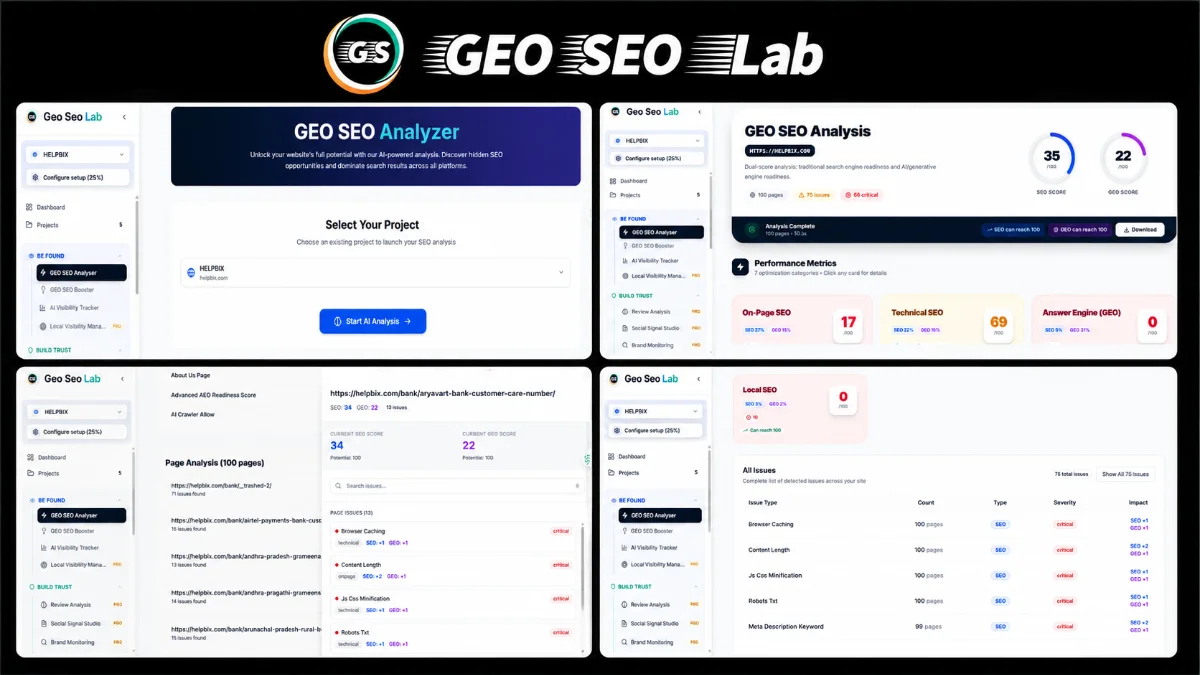
GEO SEO Analyzer Dashboard Overview :-
Why Every Website Needs a GEO SEO Audit in 2026
The digital landscape is changing at an unprecedented pace. Traditional SEO is no longer the only factor that determines online success. As AI-powered search platforms become more intelligent and widely adopted, website owners need deeper insights into how their websites perform—not only for search engines like Google and Bing but also for AI assistants that generate answers for millions of users every day.A modern website may look visually appealing and even rank for several keywords, yet still struggle to attract meaningful traffic. Slow-loading pages, weak content structure, poor internal linking, missing schema markup, inconsistent local SEO signals, or the absence of AI-friendly content can significantly reduce visibility. These hidden issues often go unnoticed until rankings decline or competitors begin outperforming your website.
This is why regular SEO audits have evolved into comprehensive GEO SEO audits. Instead of focusing on a limited set of technical checks, modern audits evaluate the complete health of a website, including technical performance, content quality, semantic relevance, user experience, authority signals, and AI readiness.For bloggers, this means ensuring articles are well-structured, easy to understand, and capable of being cited by AI systems when users ask related questions. Long-form, authoritative, and entity-rich content has become increasingly valuable because AI models favor content that clearly answers user intent.For eCommerce businesses, GEO optimization goes beyond product pages. AI platforms increasingly recommend products, compare features, summarize reviews, and answer shopping-related questions. Websites with structured product data, rich descriptions, optimized images, FAQs, and trust signals are more likely to be referenced in these AI-generated recommendations.Digital marketing agencies also benefit significantly from advanced website audits. Managing multiple client websites requires a scalable way to identify critical issues, prioritize fixes, and demonstrate measurable improvements. A detailed audit report enables agencies to communicate technical findings clearly while creating actionable optimization roadmaps for clients.Local businesses face an entirely different challenge. Restaurants, clinics, law firms, educational institutes, real estate agencies, and service providers rely heavily on location-based searches. Missing Google Business Profile optimization, inconsistent Name-Address-Phone (NAP) information, weak local citations, or incomplete local schema can reduce visibility in both traditional local search results and AI-powered location recommendations.Software companies and SaaS businesses often publish knowledge bases, documentation, blogs, and landing pages to educate potential customers. AI systems frequently use these resources when answering technical or product-related questions. If the content lacks semantic depth, structured headings, clear explanations, or entity optimization, the opportunity to gain AI citations may be lost.Publishers and news websites must also adapt to changing search behavior. Instead of waiting for users to click through search results, many readers now consume AI-generated summaries. Creating trustworthy, well-sourced, and context-rich content improves the likelihood that AI systems will reference the original publisher while maintaining credibility.Educational institutions and online learning platforms can leverage GEO optimization by creating structured educational content that answers specific learner questions. Tutorials, guides, FAQs, and instructional resources become more valuable when they are easy for both users and AI systems to interpret.Healthcare organizations, finance websites, and legal service providers operate in highly competitive industries where trust and expertise are essential. Strong E-E-A-T signals, author information, references, structured data, and secure website architecture are increasingly important—not only for search engines but also for AI systems that prioritize reliable information.Even startup companies and personal brands can benefit from comprehensive website audits. A technically optimized website with high-quality content, strong internal linking, proper schema implementation, and AI-friendly formatting creates a solid foundation for long-term organic growth.The reality is simple: every website has strengths, weaknesses, and hidden opportunities. Without a comprehensive audit, it is difficult to know which issues deserve immediate attention and which improvements will deliver the greatest impact. By combining traditional SEO analysis with Generative Engine Optimization insights, businesses gain a complete understanding of their online presence and receive a clear roadmap for improving both search rankings and AI visibility.In 2026, success is no longer measured solely by where your website ranks on Google. It is also measured by whether AI platforms can discover, understand, trust, and recommend your content. A comprehensive GEO SEO audit ensures your website is prepared for both today's search engines and tomorrow's AI-driven search experiences.
How the GEO SEO Analyzer Works
Many SEO audit tools generate long reports filled with technical metrics but provide little context about what those numbers actually mean. As a result, website owners often receive dozens—or even hundreds—of warnings without knowing which issues are truly critical or where they should begin.Geo SEO Lab's GEO SEO Analyzer takes a different approach. Instead of simply listing errors, it performs a comprehensive AI-powered website audit that evaluates your website from multiple perspectives, including traditional SEO performance, Generative Engine Optimization (GEO), technical health, content quality, local visibility, user experience, security, and trust signals.The goal is not just to identify problems but to explain their impact, prioritize fixes based on severity, and provide actionable recommendations that help improve both search engine rankings and AI visibility.Below is a simplified overview of how the complete analysis process works.
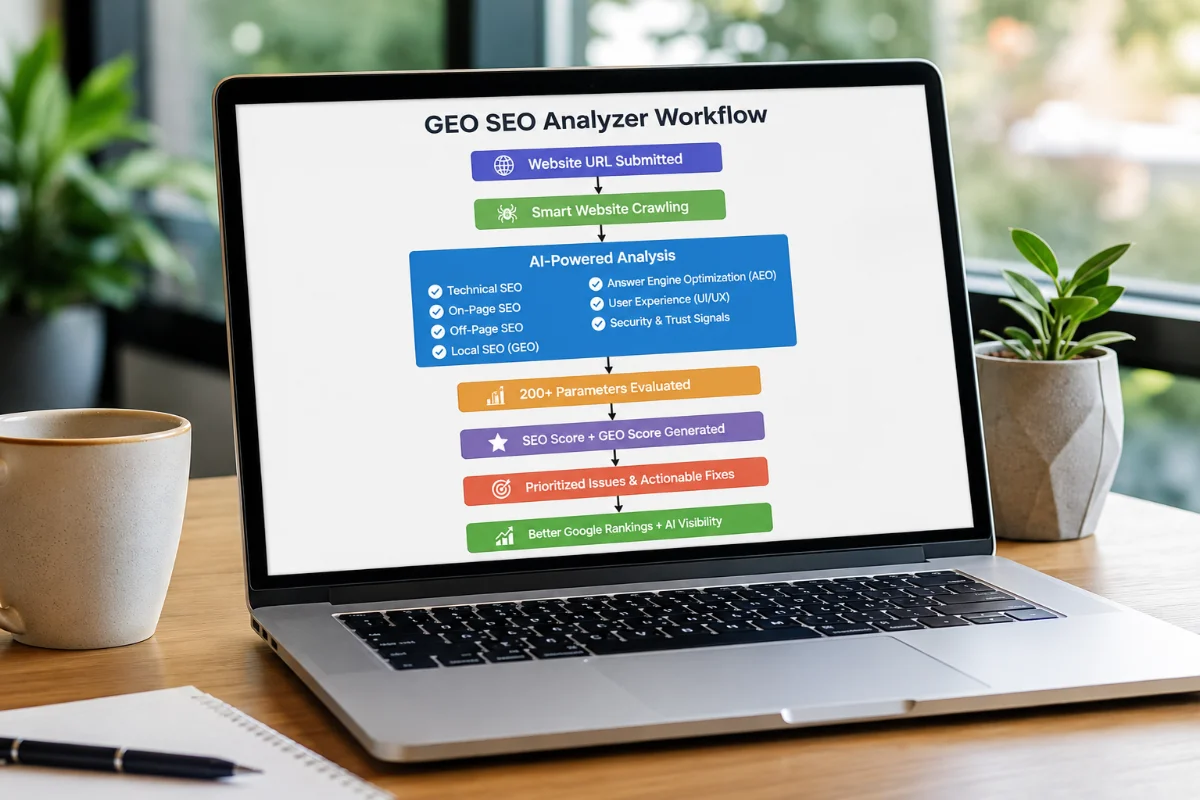
Step 1: Website Discovery & Smart Crawling
The analysis begins by crawling your website, much like a search engine bot. The crawler discovers pages through internal links, sitemaps, navigation menus, and other accessible paths. It identifies which pages can be indexed, which are blocked, and whether important content is reachable by search engines and AI crawlers.During this phase, the analyzer also detects crawl errors, broken links, redirect chains, duplicate URLs, orphan pages, canonical issues, and robots.txt restrictions that could negatively affect visibility.
Step 2: Technical SEO Analysis
Once the website has been crawled, the analyzer evaluates its technical foundation. Technical SEO is one of the most important ranking factors because search engines and AI systems both rely on a fast, accessible, and well-structured website.The audit checks factors such as:
- Core Web Vitals, Largest Contentful Paint (LCP), Interaction to Next Paint (INP), Cumulative Layout Shift (CLS), Page Speed, HTML Structure, CSS and JavaScript Optimization, Mobile Responsiveness, XML Sitemap, Canonical Tags, Robots Directives, Structured Data Validation
Each parameter is measured against recommended benchmarks to identify issues that may reduce performance or crawl efficiency.
Step 3: On-Page Content Evaluation
Content remains one of the strongest signals for both SEO and GEO. During this stage, every important page is analyzed to determine whether it satisfies user intent while remaining easy for AI systems to interpret.
The analyzer evaluates:
- SEO Titles, Meta Descriptions, Heading Hierarchy, Keyword Usage, Semantic Keyword Coverage, Entity Mentions, Internal Linking, Image Optimization, Alt Text, Readability, Content Depth, Duplicate Content, Thin Pages, Content Freshness
Instead of checking only keywords, the analyzer also evaluates topical relevance and semantic relationships to ensure content aligns with modern search algorithms.
Step 4: AI Visibility & GEO Analysis
This is one of the most unique aspects of the GEO SEO Analyzer.Traditional SEO tools primarily focus on Google's ranking factors. However, AI-powered search experiences require additional optimization that many older tools do not measure.
The analyzer evaluates whether your content is prepared for AI-generated search results by checking:
- Direct Answer Availability, Conversational Writing Style, FAQ Coverage, HowTo Content, Entity Optimization, Schema Markup, Citation Readiness, Source Credibility, Knowledge Graph Signals, AI Crawler Accessibility, Semantic Relationships, Information Completeness
These factors help determine how easily AI systems can understand, summarize, and potentially cite your content when answering user queries.
Step 5: Local SEO Evaluation
For businesses serving specific geographic locations, local visibility is just as important as traditional search rankings.
The analyzer reviews local SEO factors including:
- Google Business Profile Optimization, NAP Consistency, Local Citations, Local Schema Markup, Geo-Tagged Images, Reviews and Ratings, Service Area Optimization, Location-Specific Landing Pages, Map Visibility Signals
This helps businesses improve their chances of appearing in local search results as well as AI-generated local recommendations.
Step 6: User Experience (UX) Analysis
A technically optimized website still needs to deliver a positive experience for visitors. Search engines increasingly reward websites that provide smooth, accessible, and user-friendly experiences.
The analyzer evaluates:
- Mobile Friendliness, Navigation Structure, CTA Placement, Accessibility (WCAG), Page Layout, Scroll Behavior, Visual Stability, Interactive Elements, User Engagement Signals
A better user experience often leads to longer sessions, lower bounce rates, and improved conversions—all of which indirectly support long-term SEO performance.
Step 7: Security & Trust Assessment
Search engines and AI systems prioritize websites that demonstrate trustworthiness. Security is no longer optional—it is a foundational requirement for modern websites.
The analyzer checks:
- HTTPS Implementation, SSL Configuration, Security Headers, Cookie Consent, Privacy Policy, Terms of Service, Author Information, Organization Details, Trust Badges, Contact Information, E-E-A-T Signals
These checks help identify missing trust elements that may reduce user confidence or affect visibility in search results.
Step 8: Intelligent Scoring System
After completing all technical and content evaluations, the analyzer calculates two independent performance scores.
SEO Score
The SEO Score reflects your website's readiness for traditional search engines such as Google and Bing. It is based on technical SEO, on-page optimization, site structure, content quality, authority signals, and performance metrics.
GEO Score
The GEO Score measures how well your website is optimized for AI-powered search experiences. It considers conversational content, entity optimization, structured data, AI citation readiness, answer engine optimization (AEO), semantic relevance, and trust signals.By separating these two scores, website owners can clearly understand where they perform well and where additional optimization is needed.
Step 9: Prioritized Issue Detection
Not every issue has the same impact.
Rather than overwhelming users with hundreds of recommendations, the analyzer categorizes findings based on severity.
Typical priority levels include:
- Critical Issues, High Priority, Medium Priority, Low Priority, Informational Recommendations
This allows teams to fix the most impactful problems first, making the optimization process faster and more efficient.
Step 10: Actionable Recommendations
The final stage transforms raw audit data into practical next steps.
For every issue detected, the analyzer provides:
- Expected Benchmark, Current Value, SEO Impact, GEO Impact, Severity Level, Why It Matters, Recommended Fix
Instead of guessing what to do next, users receive a structured roadmap that helps improve website performance over time.Whether you are optimizing a personal blog, an eCommerce store, a SaaS platform, or a large enterprise website, the GEO SEO Analyzer delivers clear insights that support better decisions, stronger rankings, and greater AI visibility.
The 7 Optimization Categories
Category Primary Focus What the Analyzer Checks Why It Matters 1. On-Page SEO Content Quality & Search Relevance SEO titles, meta descriptions, heading hierarchy (H1–H6), keyword optimization, semantic keywords, internal linking, image alt text, readability, content depth, duplicate content Helps search engines and AI understand your content, improving rankings and user engagement. 2. Technical SEO Website Performance & Crawlability Core Web Vitals (LCP, INP, CLS), page speed, mobile responsiveness, XML sitemap, robots.txt, canonical tags, structured data, crawl errors, indexing issues Ensures your website is fast, crawlable, indexable, and technically optimized for Google and AI crawlers. 3. Off-Page SEO Authority & Trust Signals Backlink quality, referring domains, anchor text diversity, toxic backlinks, brand mentions, online reputation Builds domain authority, improves credibility, and increases the likelihood of AI citations. 4. Local SEO (GEO) Local Search Visibility Google Business Profile, NAP consistency, local citations, local schema markup, geo-tagged images, customer reviews, location pages Improves visibility in Google Maps, local search results, and AI-powered local recommendations. 5. AEO / Answer Engine Optimization AI Search & Citation Readiness Direct answers, FAQ & HowTo schema, entity optimization, conversational content, citation readiness, AI crawler accessibility Increases the chances of appearing in ChatGPT, Gemini, Perplexity, Google AI Overviews, and other AI-generated answers. 6. UI/UX User Experience & Engagement Mobile usability, navigation, accessibility (WCAG), CTA placement, scroll depth, readability, page layout, visual hierarchy Enhances user satisfaction, reduces bounce rate, and supports better SEO performance. 7. Security & Trust Website Security & E-E-A-T HTTPS/SSL, security headers, privacy policy, cookie consent, author bios, organization details, trust badges, E-E-A-T signals Builds trust with users, search engines, and AI systems while strengthening long-term authority.
The analyser doesn’t give generic advice. It scores every parameter with expected benchmarks, real values from your site, scoring logic, and fix suggestions.
Here’s what it deeply evaluates:
1.Category:- On-Page SEO
Focus Area:- Content quality & keyword strategy
Parameters Checked:- Title length (30-70 chars), Meta description, H1/H2/H3 usage, Keyword density (0.8-2%), Content length (1500+ words), Internal links, LSI terms, Readability
Why On-Page SEO Still Matters in the AI Search Era
On-page SEO remains the foundation of every successful website. Regardless of how search technology evolves, search engines and AI systems still rely on well-structured, informative, and relevant content to understand what a page is about. A page with poor titles, weak headings, thin content, or confusing structure becomes difficult for both users and AI models to interpret.The GEO SEO Analyzer evaluates every important on-page element against modern SEO and GEO best practices. Rather than checking whether a keyword simply exists on the page, the analyzer measures whether content satisfies user intent, follows a logical hierarchy, and provides enough context for both traditional search engines and generative AI platforms.
SEO Title Analysis
The title tag is often the first thing users see in search results. It also helps search engines understand the primary topic of a page. Titles that are too short may not provide enough context, while titles that are too long may be truncated in search results.The analyzer checks whether your SEO titles remain within the recommended character range while naturally incorporating primary keywords without keyword stuffing.
Meta Description Optimization
Although meta descriptions are not direct ranking factors, they strongly influence click-through rates. A compelling description encourages users to visit your website instead of a competitor's.The analyzer evaluates description length, keyword placement, uniqueness, and whether the description clearly summarizes the page.
Heading Structure (H1, H2 & H3)
Proper heading hierarchy improves both readability and crawlability.
The audit identifies issues such as:
- Multiple H1 Tags, Missing H1, Skipped Heading Levels, Poor Heading Hierarchy, Keyword Stuffing in Headings
A logical structure helps AI systems identify the most important sections of your content.
Keyword Usage
Modern SEO focuses on natural language rather than repeating the same keyword excessively.
The analyzer evaluates:
- Primary Keyword Placement, Keyword Density, Semantic Keyword Coverage, Related Entities, Contextual Relevance
This ensures your content remains optimized without appearing unnatural.
Content Quality
High-quality content demonstrates expertise, experience, authority, and trust.
The analyzer reviews:
- Content Depth, Word Count, Duplicate Content, Thin Pages, Readability, Freshness, Topical Completeness
Long-form content that answers multiple user questions generally performs better in both search engines and AI-generated responses.
Internal Linking
Internal links distribute authority across your website while helping visitors discover related information.The analyzer identifies pages with insufficient internal links and recommends opportunities to improve website architecture.
Readability & User Experience
Even technically correct content can fail if users find it difficult to read.
The analyzer evaluates:
- Sentence Length, Paragraph Structure, Passive Voice, Reading Difficulty, Content Formatting
Clear, well-organized content is easier for readers to consume and easier for AI systems to summarize accurately.
A strong on-page SEO strategy not only improves rankings but also increases the likelihood that AI assistants will reference your content when answering relevant questions.
2.Category:- Technical SEO
Focus Area:- Speed, crawlability & structure
Parameters Checked:- Core Web Vitals (LCP, INP, CLS), JS/CSS minification, Robots.txt, Canonical tags, Structured data/schema, Page speed
Why Technical SEO Is the Foundation of Search Performance
Technical SEO ensures that search engines, AI crawlers, and users can access, understand, and navigate your website efficiently. Even the highest-quality content may struggle to rank if the website suffers from slow loading speeds, crawl errors, broken technical configurations, or indexing problems.The GEO SEO Analyzer performs a comprehensive technical audit to uncover hidden issues that affect both traditional SEO rankings and AI visibility. Every technical factor is evaluated against modern best practices, allowing website owners to identify problems before they impact traffic or user experience.
Core Web Vitals Analysis
Google's Core Web Vitals measure how users experience your website in real-world conditions. The analyzer evaluates all major metrics, including:
- Largest Contentful Paint (LCP), Interaction to Next Paint (INP), Cumulative Layout Shift (CLS), First Contentful Paint (FCP), Time to First Byte (TTFB), Speed Index, Total Blocking Time (TBT)
These metrics help determine whether pages load quickly, remain visually stable, and respond smoothly to user interactions.
Page Speed Optimization
Fast websites improve user satisfaction, reduce bounce rates, and increase conversion rates. The analyzer identifies factors that slow down page performance, including:
- Largest Contentful Paint (LCP), Interaction to Next Paint (INP), Cumulative Layout Shift (CLS), First Contentful Paint (FCP), Time to First Byte (TTFB), Speed Index, Total Blocking Time (TBT)
Each issue includes recommendations to improve loading performance.
JavaScript & CSS Optimization
Modern websites often rely heavily on JavaScript frameworks, but excessive or poorly optimized code can negatively impact performance.
The analyzer checks:
- Largest Contentful Paint (LCP), Interaction to Next Paint (INP), Cumulative Layout Shift (CLS), First Contentful Paint (FCP), Time to First Byte (TTFB), Speed Index, Total Blocking Time (TBT)
These optimizations help reduce page size and improve loading speed.
Crawlability & Indexing
If search engines cannot crawl your website correctly, important pages may never appear in search results.
The analyzer evaluates:
- Largest Contentful Paint (LCP), Interaction to Next Paint (INP), Cumulative Layout Shift (CLS), First Contentful Paint (FCP), Time to First Byte (TTFB), Speed Index, Total Blocking Time (TBT)
These checks ensure that search engines and AI bots can efficiently discover and index your content.
URL Structure & Canonicalization
Clean URLs improve both usability and search engine understanding.
The analyzer reviews:
- Largest Contentful Paint (LCP), Interaction to Next Paint (INP), Cumulative Layout Shift (CLS), First Contentful Paint (FCP), Time to First Byte (TTFB), Speed Index, Total Blocking Time (TBT)
Proper canonical implementation helps prevent duplicate content problems.
Structured Data & Schema Validation
Structured data provides additional context about your website to search engines and AI systems.
- argest Contentful Paint (LCP), Interaction to Next Paint (INP), Cumulative Layout Shift (CLS), First Contentful Paint (FCP), Time to First Byte (TTFB), Speed Index, Total Blocking Time (TBT)
Correct schema implementation increases eligibility for rich results and improves AI understanding of your content.
Mobile Optimization
More than half of all web traffic comes from mobile devices, making mobile performance essential.
- Largest Contentful Paint (LCP), Interaction to Next Paint (INP), Cumulative Layout Shift (CLS), First Contentful Paint (FCP), Time to First Byte (TTFB), Speed Index, Total Blocking Time (TBT)
A mobile-friendly website provides a better experience for users across all devices.
Technical Security Signals
Security is a critical ranking and trust factor.
The analyzer evaluates:
- Largest Contentful Paint (LCP), Interaction to Next Paint (INP), Cumulative Layout Shift (CLS), First Contentful Paint (FCP), Time to First Byte (TTFB), Speed Index, Total Blocking Time (TBT)
These signals help protect both users and website integrity.
Why Technical SEO Matters for AI Search
AI search engines rely on structured, accessible, and high-performing websites to retrieve and summarize information accurately. A technically optimized website is easier to crawl, understand, and cite, improving visibility across both traditional search engines and AI-powered platforms.
By identifying and resolving technical issues early, businesses can build a stronger foundation for sustainable SEO performance, better user experience, and long-term AI visibility.
3.Category:- Off-Page SEO
Focus Area:- Authority & backlinks
Parameters Checked:- Backlink quality, Referring domains, Anchor text diversity, Toxic links, Brand mentions
Why Off-Page SEO Matters for Website Authority and AI Visibility
Off-page SEO focuses on everything that happens outside your website but influences how search engines and AI systems evaluate your authority, trustworthiness, and reputation.While on-page SEO helps search engines understand what your website is about, off-page SEO helps determine whether your website deserves to be trusted as a reliable source of information.In the past, backlinks were mainly considered a ranking factor for Google. However, in the AI search era, authority signals have become even more important. AI systems need reliable sources when generating answers, recommendations, and summaries. Websites with strong reputation signals are more likely to be recognized as trustworthy sources.The GEO SEO Analyzer evaluates off-page factors to understand the overall authority profile of a website and identify opportunities for improving search visibility.
Backlink Quality Analysis
Not all backlinks provide the same value. A single high-quality backlink from a trusted and relevant website can be more valuable than hundreds of low-quality links.
The analyzer evaluates backlink quality based on factors such as:- Domain Authority, Website Relevance, Link Placement, Editorial Value, Traffic Quality, Industry Relevance, Link Trust Signals, Follow vs Nofollow Ratio
The analyzer identifies whether backlinks are helping improve authority or creating potential risks.
Common backlink problems include:-
Links from Unrelated Websites, Low-Quality Directory Links, Spam Backlinks, Paid Link Patterns, Excessive Exact-Match Anchor Text, Links from Suspicious Domains
A healthy backlink profile should appear natural and should represent genuine recommendations from relevant sources.
Referring Domains Analysis
The number of unique websites linking to your domain is an important authority signal.
The GEO SEO Analyzer checks:
Total Referring Domains, Domain Diversity, Industry Relevance, New vs Lost Referring Domains, Authority Distribution, Link Growth Pattern
A website receiving links from many trusted sources usually demonstrates stronger credibility than a website depending on only a few domains.For example, 100 backlinks from one website may provide less value than 20 backlinks from 20 different authoritative websites.A diverse backlink profile helps search engines and AI systems understand that your brand has broader recognition across the web.
Anchor Text Diversity Evaluation
Anchor text is the clickable text used inside a backlink.
Search engines analyze anchor text to understand the context of external links. However, unnatural anchor text patterns can create risks.
The analyzer evaluates:
Branded Anchor Text, Keyword-Based Anchors, Generic Anchors, Naked URLs, Long-Tail Anchors, Over-Optimized Anchor Patterns
A natural backlink profile usually contains a balanced combination of:-
Brand Names, Website URLs, Topic-Related Phrases, Natural Language References
The analyzer detects excessive keyword-focused anchors that may appear manipulative.
Toxic Link Detection
Low-quality or spam backlinks can negatively impact website trust.
The analyzer identifies potentially harmful links from:
Spam Websites, Automated Link Networks, Irrelevant Domains, Malware Websites, Link Farms, Suspicious Directories
It evaluates:- Domain Quality, Spam Signals, Link Patterns, Relevance, Authority Indicators
Removing or managing harmful backlinks helps maintain a healthier website reputation.
Brand Mention Analysis
Brand mentions are becoming increasingly valuable in modern SEO and GEO optimization.A brand does not always need a direct backlink to create authority. Mentions across trusted websites, communities, publications, and online platforms can help establish brand recognition.
The analyzer evaluates signals such as:- Brand Mentions, Online Reputation, Digital Presence, Industry References, Entity Recognition
AI systems often rely on broader web signals to understand whether a company, website, or organization is a recognized entity.Strong brand visibility increases the chances of being considered a reliable information source.
Digital PR and Authority Building
Modern off-page SEO is not only about building links. It is about building reputation.
Effective authority-building strategies include:- Publishing Original Research, Creating Expert Content, Getting Industry Mentions, Collaborating with Trusted Websites, Participating in Expert Discussions, Building Community Presence, Earning Editorial Coverage
These activities create natural authority signals that benefit both SEO and GEO performance.
Off-Page SEO and E-E-A-T Signals
Google and AI systems increasingly evaluate Experience, Expertise, Authoritativeness, and Trustworthiness (E-E-A-T).
Off-page signals contribute heavily to authority by showing:- Who References Your Website, Which Communities Recognize Your Brand, Whether Experts Mention Your Content, How Trustworthy Your Online Reputation Is
A website with strong E-E-A-T signals has a better chance of ranking higher and being cited by AI platforms.
Why Off-Page SEO Is Important for GEO
AI engines do not only analyze website content. They also consider external credibility signals when deciding which sources to trust.Strong off-page SEO helps AI systems understand:
This Website Is Recognized in Its Industry, Other Sources Reference This Information, The Brand Has Authority, The Content Is ReliableThe GEO SEO Analyzer combines backlink analysis, authority evaluation, and reputation signals to help businesses understand their true online influence.A strong off-page SEO strategy creates long-term benefits by improving rankings, increasing brand visibility, and increasing the probability of being referenced across AI-powered search experiences.
4.Category:- Local SEO (GEO)
Focus Area:- Local signals & multi-location
Parameters Checked:- GBP optimization, NAP consistency, Local schema, Citations, Reviews, Geo-tagged images
Why Local SEO Matters in the Age of AI Search
Local SEO has evolved far beyond appearing in Google Maps. Today, users ask AI assistants questions like "best dentist near me", "top digital marketing agency in Delhi", or "best café open now". Instead of showing only a list of websites, AI platforms generate recommendations based on trusted local business signals.To appear in these results, businesses need much more than a website. They need consistent business information, strong reputation signals, structured data, accurate location details, and a well-optimized Google Business Profile.The GEO SEO Analyzer evaluates all of these factors to help businesses improve visibility in traditional local search results as well as AI-powered local recommendations.
Google Business Profile (GBP) Optimization
A Google Business Profile is one of the strongest local ranking signals.The analyzer evaluates whether your profile is fully optimized by checking:
Business Name, Primary Category, Secondary Categories, Business Description, Phone Number, Website URL, Address Accuracy, Business Hours, Attributes, Service Areas, Appointment Links, Products and Services, Photos and Videos, Questions & Answers, Regular Business Posts
Incomplete profiles often lose visibility in both Google Search and Google Maps.
NAP Consistency Analysis
NAP stands for:- Name, Address, Phone Number
Consistency across all online platforms is critical.The analyzer compares business information across multiple locations and identifies issues such as:- Different Business Names, Incorrect Phone Numbers, Old Addresses, Missing Suite Numbers, Different Business Formats, Duplicate Listings
Consistent NAP information helps search engines confidently identify your business.
Local Citation Analysis
Local citations are mentions of your business information on trusted directories and websites.
The analyzer evaluates:-
Citation Consistency, Missing Listings, Duplicate Citations, Incomplete Business Information, High-Authority Directories, Industry-Specific Directories
Strong citation profiles improve local trust and strengthen business authority.
Local Schema Markup
Schema markup helps search engines understand detailed business information.
The analyzer validates Local Business Schema including:
Business Name, Address, Coordinates, Opening Hours, Contact Details, Reviews, Ratings, Service Area, Business Type, Logo, Website
Correct schema implementation improves eligibility for rich search features and AI interpretation.
Customer Reviews & Reputation Signals
Reviews are one of the strongest indicators of trust.
The analyzer evaluates:- Total Review Count, Average Rating, Review Freshness, Response Rate, Review Consistency, Sentiment Trends
Businesses with authentic, positive, and regularly updated reviews are more likely to rank well and earn user trust.
Geo-Tagged Images
Images can also strengthen local SEO.
The analyzer checks:- Optimized Image Filenames, Alt Text, Image Compression, Geo-Related Relevance, Location-Specific Content
Well-optimized images support both search visibility and local relevance.
Multi-Location SEO
Businesses operating in multiple cities require a scalable local SEO strategy.
The analyzer evaluates:-Location Landing Pages, Unique Local Content, Internal Linking Between Locations, City-Specific Metadata, Individual Schema for Each Branch, Duplicate Location Content
This helps each location compete independently in local search results.
AI-Ready Local Search Signals
AI-powered search platforms increasingly rely on structured local data when recommending businesses.
The GEO SEO Analyzer checks whether your business provides:- Clear Location Information, Accurate Business Details, Entity Consistency, Structured Contact Information, Local Relevance, Geographic Service Coverage, Trust Signals
These elements improve the chances of being referenced when users ask location-based questions.
Why Local SEO Is Essential for GEO
Local SEO is no longer only about ranking on Google Maps. It is also about becoming the trusted business that AI assistants recommend when users search for nearby services.By combining Google Business Profile optimization, citation analysis, local schema validation, review monitoring, and AI-ready local signals, the GEO SEO Analyzer provides businesses with a complete roadmap for improving both local rankings and AI visibility.Whether you operate a single store or manage hundreds of business locations, optimizing local signals helps increase discoverability, build customer trust, and generate more qualified leads from both traditional search engines and the next generation of AI-powered search experiences.
5.Category:- AEO / Answer Engine Opt.
Focus Area:- AI citation & zero-click readiness
Parameters Checked:- Direct answers, FAQ/HowTo schema, Entity mentions, Conversational content, Citations, AI crawler permissions
Why Answer Engine Optimization (AEO) Matters in 2026
Search behavior has changed dramatically over the past few years. Instead of typing short keywords into search engines, users now ask complete questions to AI-powered assistants like ChatGPT, Google AI Overviews, Gemini, Claude, Perplexity AI, and Microsoft Copilot.Rather than displaying a list of blue links, these platforms generate direct answers by collecting, understanding, and summarizing information from trusted websites. This shift has introduced a new optimization discipline known as Answer Engine Optimization (AEO).AEO focuses on making your content easy for AI systems to understand, summarize, and reference. The GEO SEO Analyzer evaluates whether your website is prepared for this new generation of AI-powered search experiences.
Direct Answer Optimization
AI platforms prioritize pages that provide clear and concise answers to common user questions.
The analyzer evaluates whether your content includes:- Direct Answers, Definition Paragraphs, Question-Based Headings, Featured Snippet Opportunities, Summary Sections, Step-by-Step Explanations
Content that immediately answers user intent has a higher chance of being surfaced by AI systems.
Conversational Content Analysis
Modern AI search understands natural language.Instead of optimizing only for keywords, websites should write content that answers questions the way people naturally ask them.
The analyzer checks:- Natural Language Usage, Conversational Writing Style, Question-and-Answer Formatting, Readability, Contextual Explanations, Topic Completeness
Content written for humans is generally easier for AI systems to interpret accurately.
Entity Recognition & Semantic SEO
AI engines rely heavily on entities rather than isolated keywords.
Entities include:- People, Companies, Products, Services, Locations, Technologies, Organizations, Events
The analyzer evaluates:- Entity Coverage, Entity Relationships, Topic Relevance, Semantic Consistency, Knowledge Graph Alignment
Strong entity optimization helps AI understand the real meaning of your content.
FAQ Schema Optimization
Frequently Asked Questions improve both user experience and AI readability.
The analyzer checks:- FAQ Availability, Schema Implementation, Question Uniqueness, Answer Quality, Content Consistency, Structured Formatting
Well-written FAQs often increase the chances of appearing in AI-generated responses and rich search results.
HowTo Content Evaluation
Tutorials and instructional content perform exceptionally well in answer engines.
The analyzer evaluates:- Clear Step-by-Step Instructions, Ordered Structure, Supporting Images, Time Estimates, Required Tools or Materials, HowTo Schema Implementation
Structured instructional content is easier for AI systems to summarize and recommend.
AI Citation Readiness
Being indexed is no longer enough. The next goal is becoming a source that AI platforms choose to reference.
The analyzer evaluates signals such as:- Original Research, Trustworthy Information, Author Attribution, Supporting Evidence, Citation-Worthy Formatting, Reference Quality, Information Accuracy, Topical Authority
These factors increase the likelihood that your content will be selected when AI systems generate answers.
AI Crawler Accessibility
If AI crawlers cannot access your content, your chances of appearing in AI-generated answers are reduced.
The analyzer checks:- AI Crawler Permissions, Robots.txt Compatibility, Crawl Accessibility, Structured Content Availability, Indexable Resources, Machine-Readable Formatting
Ensuring accessibility allows AI platforms to discover and understand your content more effectively.
Zero-Click Search Readiness
Many users now receive answers directly from search engines or AI assistants without visiting multiple websites.
To compete in this environment, websites need content that is:- Clearly Structured, Factually Accurate, Easy to Summarize, Rich in Entities, Supported by Schema, Written with User Intent in Mind
The analyzer evaluates whether your pages are prepared for these zero-click experiences while still encouraging users to explore your website further.
E-E-A-T Signals for AI Search
Experience, Expertise, Authoritativeness, and Trustworthiness (E-E-A-T) are increasingly important for both traditional search engines and AI systems.
The analyzer reviews:- Author Bios, Organization Information, Editorial Transparency, Contact Details, Privacy Policies, Content Freshness, Supporting References, Industry Expertise
These trust signals help AI systems determine whether your content is reliable enough to recommend.
Content Freshness & AI Relevance
AI systems often prefer content that is accurate and up to date.
The analyzer checks:- Publication Date, Last Updated Date, Outdated Statistics, Broken References, Content Freshness, Topic Completeness
Regularly updated content demonstrates ongoing expertise and improves long-term visibility.
Why AEO Is the Future of Search
Traditional SEO helps your website rank in search engines. AEO helps your content become the answer itself.
As AI-powered search continues to grow, websites that combine technical SEO, semantic optimization, structured data, entity recognition, and trustworthy content will have a significant competitive advantage.The GEO SEO Analyzer bridges the gap between traditional SEO and Answer Engine Optimization by measuring not only how well your pages rank, but also how effectively they communicate with AI systems.Whether your goal is to appear in featured snippets, Google AI Overviews, ChatGPT responses, or other AI-generated search experiences, AEO provides the framework needed to increase discoverability, credibility, and long-term digital visibility.
6.Category:- UI/UX
Focus Area:- User experience & engagement
Parameters Checked:- Mobile friendliness, Scroll depth, Bounce rate, CTA placement, Accessibility (WCAG), Dark mode
Why User Experience (UI/UX) Is Critical for SEO and GEO
A visually attractive website is no longer enough. Modern search engines and AI systems increasingly evaluate how users interact with your website. If visitors struggle to navigate pages, experience slow interactions, or leave quickly, these behavioral signals may indicate that the content is not meeting user expectations.The GEO SEO Analyzer evaluates user interface (UI) and user experience (UX) factors that influence engagement, usability, accessibility, and long-term search performance.A well-designed website encourages visitors to stay longer, explore more pages, complete desired actions, and trust your brand. These positive engagement signals indirectly contribute to stronger SEO performance while also making content easier for AI systems to interpret.
Mobile Friendliness Analysis
More than half of global web traffic comes from mobile devices. A website that performs poorly on smartphones can lose visitors, rankings, and potential customers.
The analyzer evaluates:- Responsive Design, Mobile Viewport Configuration, Font Readability, Button Size and Spacing, Touch-Friendly Navigation, Horizontal Scrolling Issues, Mobile Image Optimization, Responsive Media Elements, Mobile Page Speed, Device Compatibility
A mobile-friendly website provides a smoother browsing experience and aligns with Google's mobile-first indexing approach.
Navigation & Site Structure
Users should be able to reach important pages quickly without confusion.
The analyzer reviews:-
Navigation Menu Structure, Breadcrumb Implementation, Internal Navigation, Footer Navigation, Click Depth, Logical Page Hierarchy, Category Organization, Search Functionality
Clear navigation improves usability while helping search engines and AI crawlers understand website architecture.
Scroll Depth & User Engagement
Scroll depth measures how much of a webpage users actually consume.
The analyzer evaluates whether content encourages visitors to continue reading by analyzing factors such as:- Content Placement, Visual Hierarchy, Section Spacing, Heading Distribution, Interactive Elements, Long-Form Content Structure
Well-structured pages generally keep users engaged for longer periods.
Bounce Rate Optimization
A high bounce rate may indicate that visitors leave the page without exploring additional content.
The analyzer identifies factors that contribute to poor engagement, including:- Slow Loading Pages, Weak Introductions, Poor Readability, Irrelevant Content, Missing Internal Links, Confusing Layouts, Intrusive Pop-Ups, Lack of Trust Signals
Improving these areas can encourage users to spend more time on your website.
Call-to-Action (CTA) Analysis
Every important page should guide visitors toward a meaningful next step.
The analyzer evaluates:- CTA Visibility, CTA Placement, Button Clarity, Design Consistency, Conversion Opportunities, Multiple CTA Conflicts
Whether your goal is lead generation, product sales, newsletter subscriptions, or demo bookings, strategically placed CTAs improve user engagement and conversions.
Accessibility (WCAG) Evaluation
Accessible websites create a better experience for everyone, including users with disabilities.
The analyzer checks accessibility best practices such as:- Image Alt Text, Color Contrast, Keyboard Navigation, Form Labels, Heading Hierarchy, ARIA Attributes, Link Accessibility, Focus Indicators, Readable Typography
Improving accessibility not only benefits users but also helps search engines understand page content more effectively.
Dark Mode & Visual Comfort
Dark mode has become a common user preference across modern devices.
The analyzer evaluates whether your website supports:- Dark Mode Compatibility, Consistent Color Schemes, Readable Typography, Contrast Optimization, Icon Visibility, Image Adaptation
Providing flexible display options enhances usability and improves the overall browsing experience.
Readability & Content Presentation
Even high-quality information can lose value if it is difficult to read.
The analyzer reviews:- Paragraph Length, Sentence Complexity, Heading Distribution, Bullet List Usage, Tables and Visual Organization, White Space, Font Size, Line Spacing
Well-formatted content keeps visitors engaged while making information easier for AI systems to process.
UX Signals That Influence SEO
Search engines increasingly reward websites that provide positive user experiences.
The analyzer evaluates engagement-related factors including:- Session Duration, Page Interaction, Content Consumption, Navigation Flow, Return Visits, Internal Page Exploration
Although user behavior is influenced by many factors, improving usability often leads to stronger long-term SEO performance.
Why UI/UX Matters for AI Visibility
AI systems prefer content that is structured, readable, and easy to interpret.
A well-designed page with clear headings, logical layouts, concise paragraphs, accessible navigation, and meaningful visual hierarchy allows AI models to extract information more accurately.The GEO SEO Analyzer combines traditional usability analysis with AI-focused content evaluation to ensure your website delivers an excellent experience for both human visitors and intelligent search systems.By improving UI and UX, businesses not only increase engagement and conversions but also strengthen their chances of being understood, trusted, and referenced across the next generation of AI-powered search experiences.
7.Category:- Security & Trust
Focus Area:- E-E-A-T + security signals
Parameters Checked:-HTTPS/SSL strength, Security headers, Privacy policy, Cookie consent, Author bios, Trust badges
Why Security & Trust Are Essential for SEO, GEO, and AI Search
Trust has become one of the most important ranking signals in modern search. Whether a user is searching on Google or asking an AI assistant for information, websites that demonstrate credibility, transparency, and security are more likely to earn visibility.Search engines aim to recommend trustworthy websites, while AI platforms prefer reliable sources that provide accurate, secure, and verifiable information. Even a technically optimized website may struggle to build authority if users cannot trust the business behind it.The GEO SEO Analyzer evaluates both technical security and trust-related signals to help businesses strengthen credibility across traditional search engines and AI-powered search platforms.
HTTPS & SSL Certificate Analysis
Secure websites protect user data and establish confidence.
The analyzer evaluates:- HTTPS Implementation, SSL Certificate Validity, Certificate Expiration, Mixed Content Issues, Secure Redirects, HTTPS Enforcement, HTTP to HTTPS Redirection, TLS Configuration
Common issues detected include:- Expired SSL Certificates, Mixed HTTP/HTTPS Resources, Broken Secure Connections, Missing HTTPS Redirects, Invalid Certificate Chains
A properly configured HTTPS website protects user privacy while improving trust and search visibility.
Security Headers Evaluation
Security headers provide an additional layer of protection against common web vulnerabilities.
The analyzer validates:- Content Security Policy (CSP), HTTP Strict Transport Security (HSTS), X-Frame-Options, X-Content-Type-Options, Referrer Policy, Permissions Policy, Cross-Origin Policies
Missing or misconfigured security headers can expose websites to unnecessary risks and reduce overall trustworthiness.
Privacy Policy Analysis
Transparency is a key trust signal.
The analyzer checks whether your website provides a clear and accessible Privacy Policy that explains:- Data Collection, Cookie Usage, User Rights, Contact Information, Third-Party Services, Data Retention, Compliance Information
Well-structured privacy documentation increases user confidence and supports compliance with modern data protection regulations.
Cookie Consent Implementation
Many websites use cookies for analytics, personalization, and marketing.
The analyzer evaluates:- Cookie Banner Availability, User Consent Options, Cookie Preferences, Consent Storage, Policy Accessibility
A transparent cookie consent system demonstrates responsible data handling and builds user trust.
Author Bios & Content Credibility
Modern SEO increasingly rewards content created by identifiable experts.
The analyzer checks:- Author Profile Availability, Author Expertise, Professional Credentials, Author Profile Pages, Social Profile References, Contact Information
Clearly identified authors help search engines and AI systems understand who created the content and why it should be trusted.
Organization & Business Information
A trustworthy website clearly identifies the organization behind it.
The analyzer evaluates:- Company Information, Contact Page, Business Address, Phone Number, Email Address, Team Details, About Us Page, Social Media Profiles
Providing complete business information strengthens credibility and improves entity recognition.
Trust Badges & Social Proof
Visitors are more likely to trust websites that demonstrate credibility through recognizable trust indicators.
The analyzer reviews:- Customer Testimonials, Client Logos, Industry Certifications, Awards, Partner Badges, Secure Payment Badges, Verified Reviews
These trust signals help reassure both users and search engines that the business is legitimate.
E-E-A-T Signal Evaluation
Google emphasizes Experience, Expertise, Authoritativeness, and Trustworthiness (E-E-A-T) when evaluating content quality.
The GEO SEO Analyzer reviews signals such as:-
Demonstrated Experience, Expert Authorship, Topical Authority, Content Accuracy, Source Transparency, Editorial Quality, Brand Reputation, Consistent Publishing
Strong E-E-A-T signals improve the likelihood of earning higher rankings and greater visibility in AI-generated answers.
AI Trust Signals
AI systems evaluate much more than keywords.
The analyzer checks whether your website demonstrates:- Consistent Factual Information, Transparent Authorship, Reliable References, Structured Content, Verified Organization Details, Entity Consistency, Original Content, Information Freshness
These signals help AI models determine whether your website is a trustworthy source worth citing.
Brand Reputation & Online Authority
Trust extends beyond your own website.
The analyzer evaluates broader reputation indicators including:- Brand Mentions, Online Reviews, Industry Recognition, Media Coverage, Community Engagement, Reputation Consistency
A positive online reputation reinforces authority across both traditional search engines and AI ecosystems.
Why Security & Trust Matter for GEO
Generative AI platforms prioritize information from sources they consider reliable, transparent, and authoritative.A website with strong security, identifiable authors, structured organization data, positive reputation, and high-quality content is significantly more likely to be trusted by AI systems.The GEO SEO Analyzer helps businesses identify missing trust signals, strengthen E-E-A-T, improve technical security, and create a foundation for long-term success in both search engines and AI-powered search experiences.By combining security analysis with trust evaluation, the platform ensures that your website is not only optimized for rankings but also prepared to become a reliable source in the future of AI search.
Total parameters: 200+ across on-page, technical, local, AEO, UX, security, and emerging 2025-2026 trends like schema depth and AI-specific signals.
Real Example: Analysis of https://helpbix.com/
When we ran the tool on https://helpbix.com/:
SEO Score: 35/100
GEO Score: 22/100
Pages analyzed: 100
Total issues: 75 (66 marked critical)
Major red flags included:
- JS/CSS Minification failing on 100 pages (critical)
- Poor keyword density, content length, and internal linking on most pages
- Missing local SEO and AEO signals (zero structured answers for AI engines)
- No security headers or strong trust elements on several sections
You can drill down page-by-page (e.g., /guides/pets showed 19 issues) and see specific warnings like “Image Optimization”, “Meta Description Length”, “Security Headers”, “Lazy Loading”, etc., each with SEO/GEO impact and suggested fixes.
Why This Tool Matters in 2026?
- Over 90% of web pages still get zero organic traffic.
- AI answers are stealing clicks from traditional blue links.
- Brands that optimize for both SEO (Google) and GEO (AI engines + local) win bigger traffic, citations, and revenue.
Geo SEO Analyzer stands out because it combines deep technical crawling with AI intelligence — giving you one dashboard for traditional rankings and generative visibility.
Ready to Discover Your Website’s True Scores?
Head to → geoseolab.com/dashboard/geo-seo-analyzer
Add your website (free beta access available)
Run the AI analysis in seconds
Get your full report + prioritized action items
Ready to Make Your Website AI Search Ready?
The future of search is changing faster than ever. Ranking on Google is still important, but modern businesses need to prepare for a world where users discover information through AI-powered search engines, answer engines, and intelligent assistants.A website that is optimized only for traditional SEO may miss valuable opportunities in the AI search era. To stay competitive, businesses need to understand how search engines and AI platforms view their website today.Geo SEO Lab’s GEO SEO Analyzer helps you discover your website’s complete SEO and GEO performance with a detailed AI-powered audit.Instead of guessing what is wrong with your website, you get a complete analysis of:
Traditional SEO Performance, AI Search Visibility, Technical Website Health, Content Quality, Local SEO Strength, User Experience, Security and Trust Signals, GEO Optimization Opportunities
Whether you are a blogger trying to increase organic traffic, an eCommerce brand looking for more customers, an agency managing multiple clients, or a business building long-term online visibility, the GEO SEO Analyzer gives you the insights needed to make smarter optimization decisions.
Why Start Your GEO SEO Audit Today?
Every day, millions of users are shifting from traditional searches to AI-powered answers. Businesses that prepare early have a stronger opportunity to gain visibility, attract qualified traffic, and build authority across multiple search platforms.
With GEO SEO Analyzer, you can:
✓ Identify hidden SEO problems affecting rankings
✓ Discover technical issues slowing down your website
✓ Understand your AI visibility score
✓ Find opportunities to appear in AI-generated answers
✓ Improve content for search engines and AI systems
✓ Strengthen local search presence
✓ Build stronger trust and authority signals
✓ Receive clear, actionable recommendations
The goal is simple: help your website become easier to discover, understand, trust, and recommend.
Take the First Step Toward Future-Proof SEO
Search is no longer limited to ten blue links. The future belongs to websites that can perform across Google Search, AI Overviews, ChatGPT-style experiences, conversational search, and emerging AI platforms.Your competitors are already optimizing for the next generation of search.Now is the time to understand where your website stands.
Visit Geo SEO Lab and run your GEO SEO Analyzer audit today.Add your website URL, analyze your performance, discover your SEO Score and GEO Score, and get a complete roadmap for improving your online visibility.
Don't just rank on search engines.
Become a trusted source for AI engines.
**Geo SEO Lab — Built for the AI Search Era.**
Start your free GEO SEO analysis today and discover how ready your website is for the future of search.
Bonus: After the audit, explore the “Deep SEO Analysis”, “GEO Optimization”, and “Actionable Insights” cards — all powered by the same advanced AI engine.
Drop your website URL in the comments if you want us to share quick insights, or book a live demo directly on the site.
Geo SEO Lab — Built for the AI Search Era.
Don’t just rank on Google. Get cited by AI engines too.
Try the GEO SEO Analyzer for free today → geoseolab.com
Frequently Asked Questions
Find answers to common questions about this topic
About the Author

Aman Kesharwani
SEO Expert & Content Creator
Experienced digital marketing professional specializing in SEO strategies, content optimization, and data-driven marketing solutions. Passionate about helping businesses grow their online presence and achieve better search rankings.
Related Articles
View all posts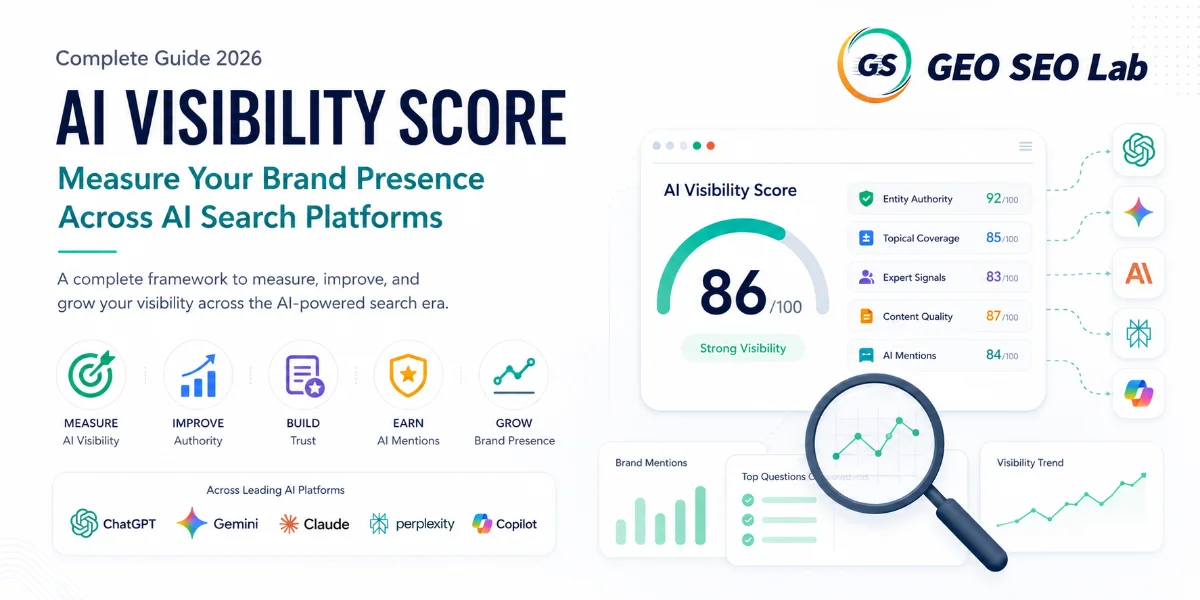
The AI Visibility Score: Measure Brand Presence Across AI Search
Learn how to measure and improve your AI Visibility Score across ChatGPT, Google AI Mode, Gemini, Claude, Perplexity, and modern AI search platforms.
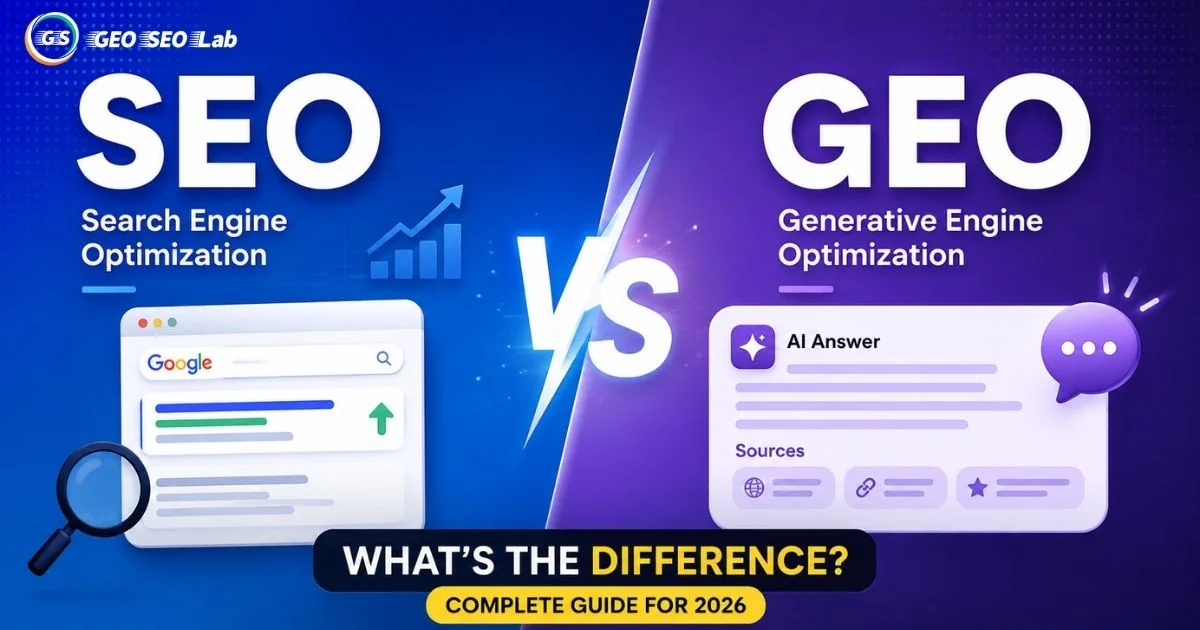
SEO vs GEO: What's the Difference? A Complete Guide for 2026
SEO vs GEO, What's the Difference, and Why Your Business Needs Both in 2026, Introduction For most of the last two decades, the goal of digital marketing c...
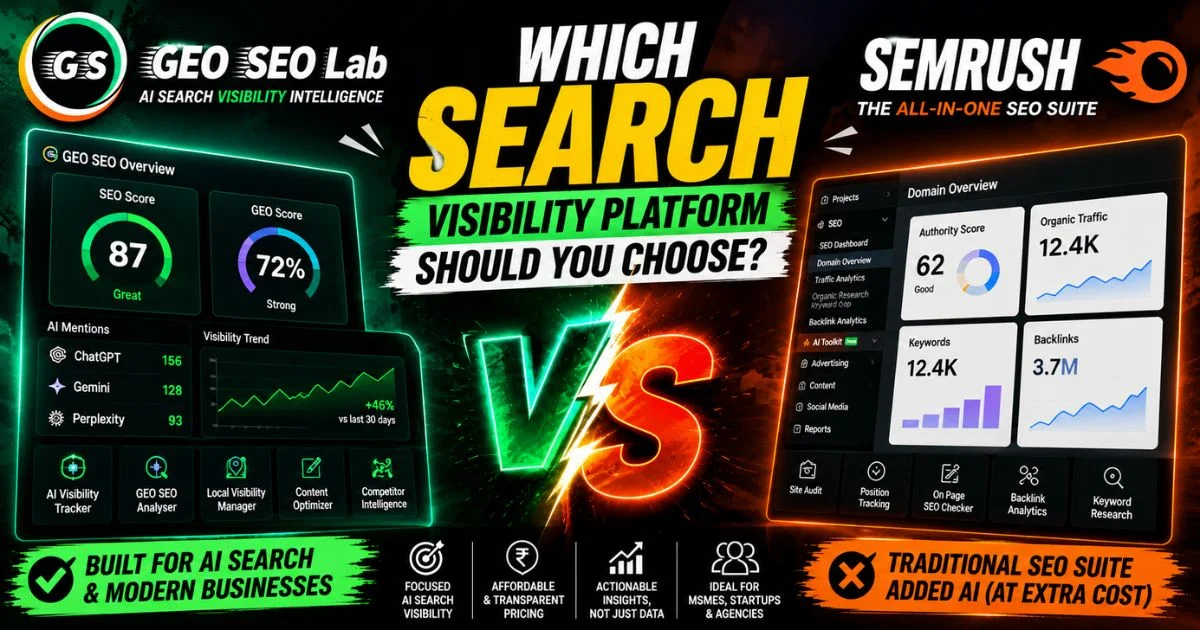
GEO SEO Lab vs Semrush: Which SEO & GEO Platform Is Best in 2026?
Picking a search visibility platform used to be a fairly narrow decision. You wanted rankings, backlinks, and maybe a competitor snapshot, and most of...